
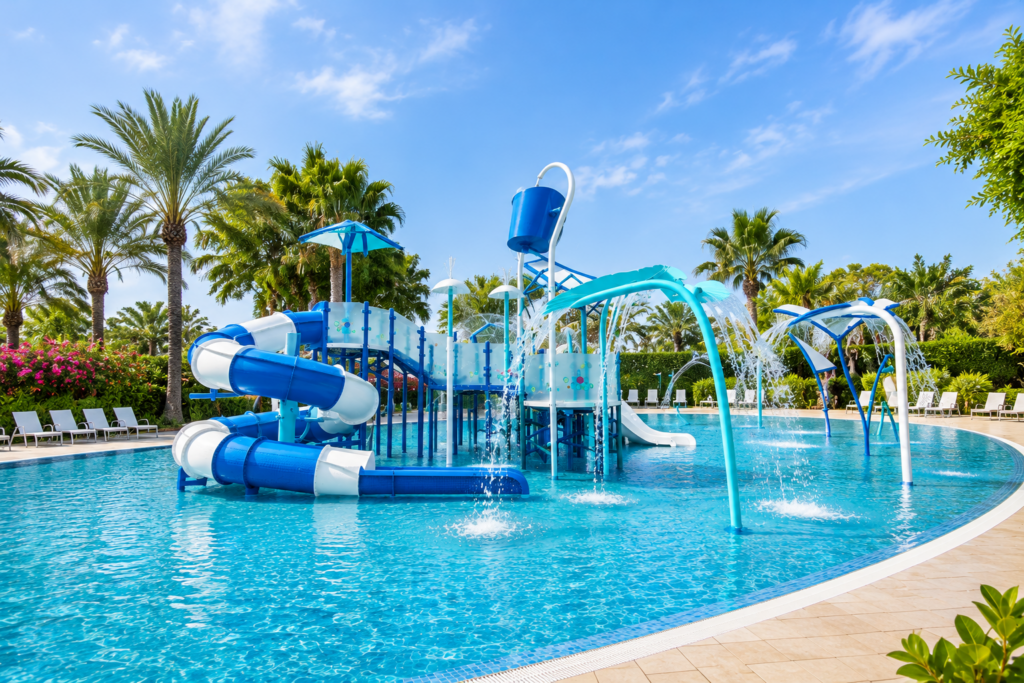
Installing a children’s water playground is becoming an increasingly popular option for adding play features to paddling pools in hotels, campsites and other aquatic leisure facilities. This solution brings together water play features with different water jets, platforms and water slides in a single attraction.
If you’re considering installing a children’s water playground at your facility, here are six technical aspects to consider regarding safety, regulatory compliance and operational efficiency.
| Element to review | Aspects to check |
|---|---|
| Integrated water slides | Classification of each slide according to its dimensions, layout and slope. |
| Landing area | Water depth, braking conditions and clear space for users to move away. |
| Play areas | Distribution of activities and circulation routes for children of different ages. |
| Splash areas | Slide run-outs, water circulation and drainage. |
| Steps, platforms and handrails | Slip resistance, surface continuity and connections after installation. |
| Spaces beneath the structure | Access, visibility, entrapment risks and rescue possibilities. |
1. Classification and height of integrated water slides
When selecting a children’s water playground, one of the aspects to consider is the type of water slides it includes and the users they are intended for. Although they may all form part of the same structure, each slide has specific characteristics that determine its classification under the EN 1069 series.
This classification takes into account the starting and landing heights, layout and slope of each slide, regardless of the overall height of the structure. A height of 3 metres is a reference for certain children’s slide categories, although being below this height does not automatically mean that a slide can be classified as suitable for children.
If you’re comparing different options, having access to the technical specifications and dimensions of each slide will help you identify the requirements applicable to its starting section, speed, landing area and instructions for use. This information will also help determine whether incorporating these slides affects the supervision and lifeguarding requirements applicable to your facility.
You can find more information in our article on water slide safety and classification under EN 1069.
2. Water depth and clear space in the landing area
The landing area is one of the factors that most influence the positioning of a water slide within a swimming pool. Users need adequate water depth at the end of the slide and sufficient space to move away from the exit.
This becomes particularly important when several play features are installed within the same pool. A wall, another play element or a circulation area may be too close to the slide exit, requiring changes to the layout even when the water depth is adequate. For this reason, the exact landing point of each slide and the surrounding clear space should be assessed.
For water slides integrated into children’s water playgrounds, The Fun Lab recommends incorporating a water braking system from the initial design stage, whether the slide ends in a pool or a zero-depth area. Its length, water level and connection to the pool or surrounding surface must be adapted and justified for each slide model, taking into account how users slow down, their remaining speed at the exit and how they leave the landing area.
Our article on technical requirements for children’s water slides explains how to determine the appropriate landing depth for each situation.
3. Play areas for children of different ages
One of the advantages of this type of facility is the possibility of combining activities for children of different ages within the same area. For example, platforms and water slides may be intended for older children, while younger children can enjoy simpler water features at ground or water level.
When planning this layout, it is also important to consider how children will move between activities. Users leaving a water slide may cross paths with younger children approaching another play feature, while queues for access to the platform may occupy part of these circulation routes.
We recommend defining separate spaces for each activity and reviewing access points, waiting areas and return routes on the layout plans. This helps organise the use of the facility and reduce interactions between different circulation flows while maintaining a variety of play activities within the same aquatic area.
The conditions of use for each element, including user restrictions, must be established based on its technical specifications and the risk assessment.
4. What changes in a zero-depth splash area?
Another option is to install the water playground in a zero-depth splash area. In this case, the design must consider how each water slide ends and the space users need to slow down, stop and leave the landing area. The water braking section and its exit must remain free from interference with ground-level play features.
Water circulation throughout the installation is another important consideration. The project must justify the required flow rate, water treatment and recirculation systems, together with adequate drainage and surface slopes to prevent water accumulation in areas where users slow down or walk.
If you’re considering this solution, the operating and supervision conditions should be defined from the beginning of the project. These will depend on the intended use, the risk assessment and the applicable regulations.
5. Safety of steps, platforms and handrails
Stairs and platforms form part of the routes children use to access play features and water slides. As these surfaces are used barefoot and are frequently wet, it is necessary to check the slip resistance of the installed finishes, including changes in materials and connections with surrounding surfaces.
The inspection also covers details such as step continuity, drainage on landings and any protrusions caused by fixings.
Particular attention should be paid to the points where handrails and protective barriers connect with stairs, panels and water slide entrances. Gaps at these connections may create fall hazards or entrapment risks involving the head or limbs.
For this reason, the inspection is carried out on the fully assembled structure, where openings and protrusions resulting from the actual installation can be identified, including those that may not be apparent in the design drawings.
6. Spaces beneath the structure and entrapment risks
When assessing a children’s water playground, it is also important to examine the spaces beneath platforms and stairs. Some of these areas may be accessible to children while remaining outside the field of vision of the personnel supervising the installation. They may also contain openings or confined spaces that are difficult to exit.
If the structure is installed within a swimming pool, it is also necessary to assess whether users can swim or dive underneath it and how a person requiring assistance could be rescued from that area.
The inspection includes supports, anchors, moving components and gaps created where different structural elements are joined together.
EN 17232, which we discuss in our article on water play equipment safety, addresses structural requirements and risks associated with access, falls and entrapment. Water slides are excluded from its scope and must be assessed according to the EN 1069 series.
When both types of equipment are integrated into the same water playground, their requirements must be considered together, including the connections between them, both during the design stage and during the inspection of the completed installation.
If you would like to conduct a water safety audit and consulting for your water park or pool, do not hesitate to contact us or visit our website for more information about our services.
We will be happy to assist you and support you with any needs related to a water leisure project. Continue browsing our blog to stay updated on our latest news, technical articles, and projects.
