
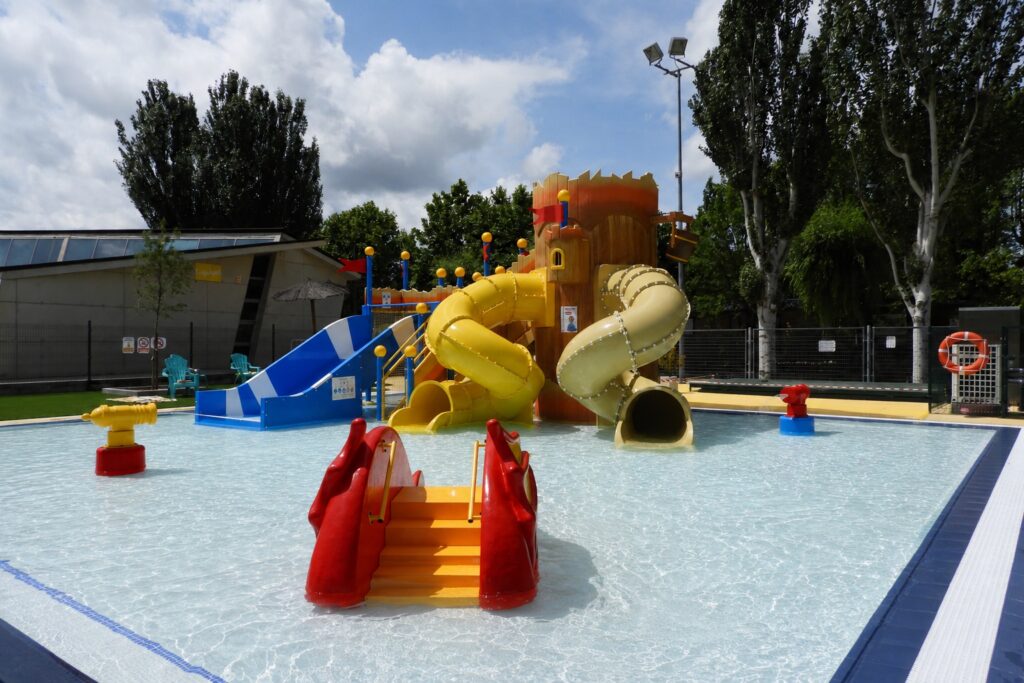
It is sometimes wrongly assumed that children’s water slides follow the same design logic, technical requirements and operational criteria as larger water slides, simply on a smaller scale.
However, the assessment of the landing area, depth, access points and surrounding environment of a children’s zone requires a different technical approach, especially when the user profile of these installations is children.
International standards themselves already take this distinction between children’s water slides and adult water slides into account in the current classification of slide typologies. To review them, you can consult our published articles on the classification of water slides under the European standard EN 1069 and the classification of water slides under ASTM standards.
In this article, we will focus more on the technical side and analyze the main design and operational requirements established by the European EN 1069 standard for children’s water slides.
1. Landing depth requirement in children’s water slides
In children’s water slides (types 1.1, 1.2, 2.1 and 2.2), the EN 1069 standard relates the depth of the pool to the vertical distance between the terminus of the slide surface and the bottom of the pool.
The standard establishes two main references for this calculation.

The standard establishes two main references for this calculation:
H: Vertical distance between the end of the slide surface and the bottom of the landing pool.
D: Water depth in the landing pool.
The key idea to take from this is that the water depth always depends on where the slide structure physically ends in relation to the pool floor.
As shown in the table, as the vertical distance increases, the regulation requires a greater minimum depth.
| Distance difference (h) between the terminus of the slide surface and the bottom of the pool, in mm | Pool depth (d), in mm |
| 0 <= h < 100 | d >= 100 |
| 100 <= h < 300 | d >= 300 |
| 300 <= h < 700 | d >= 500 |
| 700 <= h < 1200 | 1000 <= d < 1350 |
This progressive scale starts by requiring a depth of at least 100 mm for the lowest height differences and rises to between 1000 mm and 1350 mm when the distance between the slide terminus and the pool bottom ranges from 700 mm to 1200 mm.
However, in virtually all cases we have worked on throughout our experience, we almost never see an installation with children’s water slides that goes beyond the second scenario established by the standard, with a distance between 10 and 30 centimeters and a depth between 30 and 50 centimeters.
2. Free space requirement after the exit of the children’s slide
The EN 1069 standard also includes the minimum distances that must be respected from the slide exit to any type of obstruction.
| Slide type | Minimum distance from slide exit to any obstruction |
| Type 1.1 | 1.25 m |
| Type 1.2, 2.1, 2.2 | 3 m |
This point is especially relevant in children’s pools because they often group many nearby play elements together.
Although the slide may appear impeccable when analyzed in isolation, a wall, a ladder, another aquatic play element or even a busy circulation area can interfere with the user’s final trajectory and compromise the safety of the installation.
3. Minimum water flow requirement
The required water flow changes according to the type of children’s slide.
| Slide type | Minimum water flow |
| Type 1 | at least 0.18 m3/h |
| Type 2 | at least 2.4 m3/h |
This aspect brings significant value to the technical analysis because it reminds us that these aquatic installations cannot be reviewed only by measuring their height or checking their geometric shape.
Water flow completely conditions the real sliding experience, and small variations in flow are much more noticeable during use when we are dealing with a child audience.
4. Application of technical access requirements for children’s slides under EN 1069
In the access requirements established for type 1 and type 2 children’s slides, the spaces between steps must be less than 110 mm to prevent entrapment.
The operational impact of a poorly dimensioned stairway is enormous. If child users struggle to climb or need constant adult support to move up the steps, the overall pace of the installation breaks down before the child even reaches the starting point.
Correctly assessing these access points requires understanding the ergonomics and movements of younger children, setting aside from the outset the idea that a children’s installation can be solved simply by designing a conventional stairway at a smaller scale.
If you are in the development phase of a new project involving water slides, whether intended for adults or children, and you would like the support of a specialized external partner accredited by ENAC for the inspection of aquatic leisure areas, please do not hesitate to count on us.
We will be happy to assist you and support you with any needs related to a water leisure project. Continue browsing our blog to stay updated on our latest news, technical articles, and projects.
