
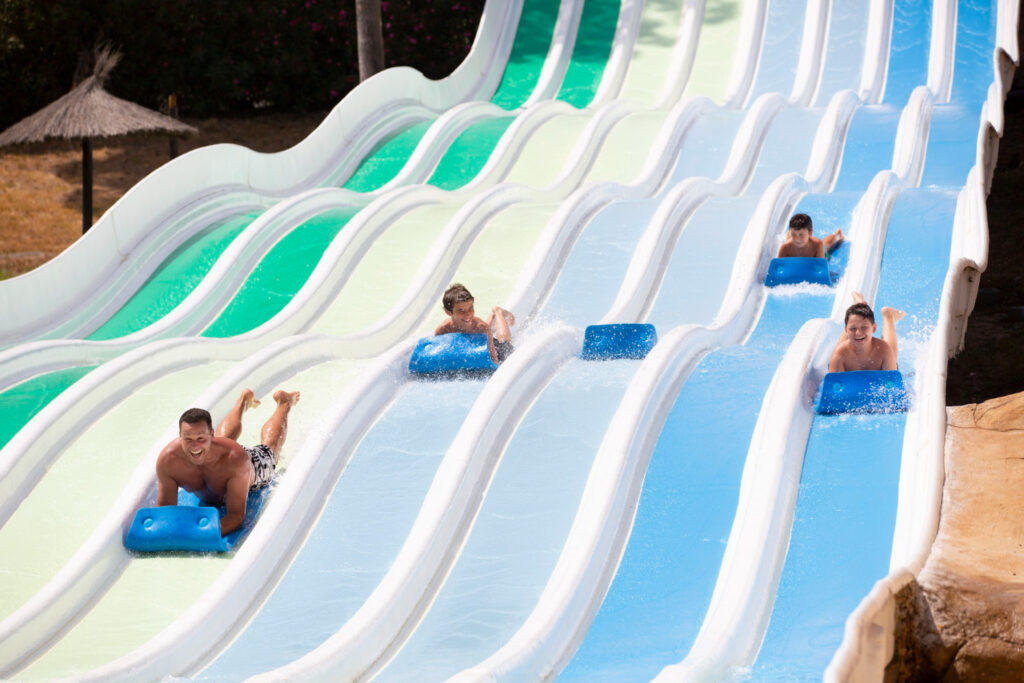
Water slides with mats allow riders to descend headfirst on a foam mat, usually fitted with handles at the front. On models known as mat racers, multiple lanes allow riders to race one another, with turns, drops or undulations depending on the design.
The mat plays an important role in how riders slide and how they reach the braking area. Its specific characteristics must therefore be considered when designing the attraction, particularly when calculating the space required in the landing pool to bring riders to a safe stop.
How are these slides classified under international EN and ASTM standards?
The European EN 1069 and American ASTM F2376 standards use different criteria to classify these slides. Under the European standard, the use of a mat is addressed within the requirements for the relevant slide type. ASTM, meanwhile, includes a specific category called a mat slide.
| Standard | Classification of water slides with mats |
| EN 1069-1 | The slide type depends on its configuration, slope and speed. Multi-lane slides meeting the relevant conditions fall under Type 6, including variants 6.1 and 6.2. |
| ASTM F2376 | The mat slide category identifies slides that use a mat as a sliding device. It is combined with other characteristics, such as the slide layout and the speed reached. |
A slide can therefore be classified as both a mat slide and a speed slide under ASTM. Its European classification depends on the characteristics of the specific model, so there is no automatic equivalence between a mat slide and a Type 6 slide.
Our articles on classification under EN 1069 and classification under ASTM F2376 explain the different slide types covered by each standard.
What changes in the design when a mat is used?
Clearances along the slide must allow riders to pass through with their mats. EN 1069-1 requires safety dimensions to be adapted to the device used, including entrances to enclosed sections and the internal diameter of tubes. For vertical clearances, it specifies an increase equal to the height of the device.
At the landing area, the speed and manner of arrival determine how much space is needed for riders to stop. Where riders continue skimming across the water in the landing pool, in what is known as a surf landing, EN requires a specific assessment to size this area. The arrival speed, the masses of the rider and mat, and the type of device must all be considered to prevent riders from reaching walls or other fixed elements.
ASTM also sets requirements affecting the landing area. A slide reaching 25 feet per second (7.62 m/s) is classified as a speed slide and, when that speed is exceeded, the standard requires additional pool length. If the slide ends in a runout, a mark must indicate the operating water level so staff can check it before allowing the next rider to descend.
The water flow rate is determined for each installation and adjusted during commissioning in accordance with the manufacturer’s specifications and applicable requirements. The use of a mat does not, in itself, justify reducing the amount of water required.
What characteristics should the mat have?
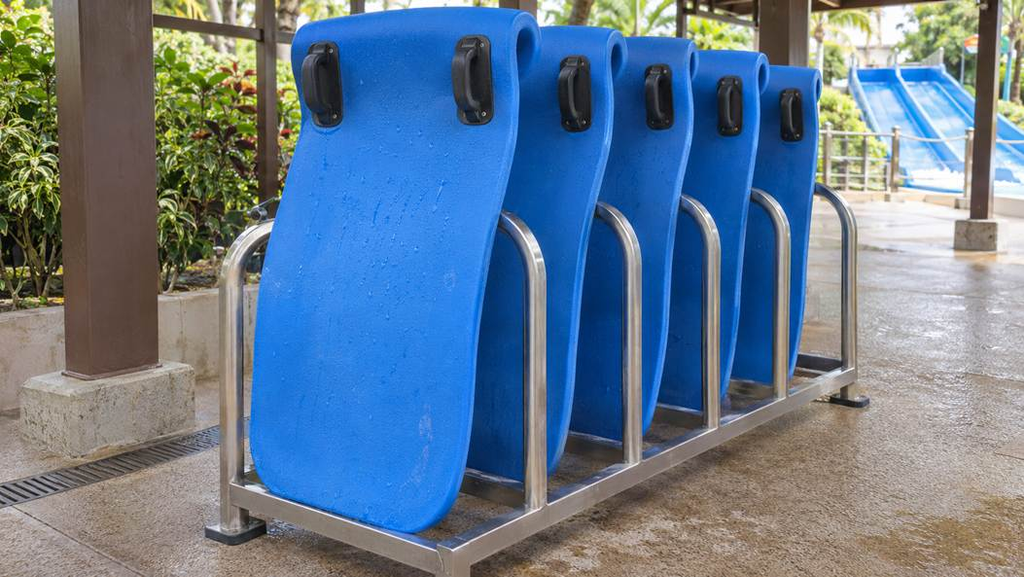
Mats come in different sizes, thicknesses and finishes and may be made from materials such as closed-cell EVA foam. Handles, where included, help riders maintain the intended position during descent.
Mats must be selected in accordance with the slide manufacturer’s specifications. This is particularly important when replacing mats at an attraction, as two mats that look similar may behave differently during the ride. Keeping a record of the original model reference makes replacement easier and helps operators check the compatibility of alternatives.
EN 1069-1 also requires devices used in landing pools to float. The design must also account for the possibility of a rider becoming separated from the mat during descent and provide for its retrieval when necessary.
How are sliding and braking performance checked?
Slide tests are carried out using the mat intended for the attraction and in the permitted riding positions. The tests check how the descent proceeds, how the rider comes to a stop and whether they can leave the landing area without interfering with subsequent riders.
Where speed and acceleration measurements are needed as part of an overall inspection, they help assess specific points along the ride and compare the results against applicable requirements. Our article on technology used in water slide inspections explains how these measurements are obtained during testing.
What should be considered during operation?
Rider preparation starts at the launch area. Riders need to understand how to orient the mat, position themselves on it and hold the handles, where provided. A demonstration by staff helps explain the riding position specified by the manufacturer before descent.
On racing slides, staff must coordinate riders’ preparation with the established dispatch intervals and check that the slide and landing area are clear for the next group.
Staff who distribute and collect mats can also spot cuts, deformation or damage to handles and their fittings. They should know the manufacturer’s maintenance and withdrawal criteria and remove damaged mats from service to prevent further use.
If you would like to conduct a water safety audit and consulting for your water park or pool, do not hesitate to contact us or visit our website for more information about our services.
We will be happy to assist you and support you with any needs related to a water leisure project. Continue browsing our blog to stay updated on our latest news, technical articles, and projects.
